Topics
Building Developer’s Role
The Developer’s roles and responsibilities are detailed in the BCCM Act

What is Handed Over?
Handover of newly Constructed Strata Titled Buildings takes place once the contract administrator has confirmed that the works defined in the contract are complete.
Handover activities should have included:
- convening the first Annual General Meeting or AGM
(when 50% of units are sold) - all body corporate records, registers and related documentation
- preparing an initial budget
(generally aligned with the disclosure statement) - lodging the initial Community Management Statement for the body corporate- which includes:
- determining a unit allotment formula for shared costs
- survey plans
- by-laws; and
- disbursements.
- paying for the first year’s insurance for the body corporate
- assigning Exclusive Use to common property – car parks; storage areas, garden areas
- engaging (i) body corporate manager; (ii) service contractor and authorizing the latter to conduct a letting business
At the first AGM, the following documents need to be handed over:
- Register of assets
- Plans, specifications, drawings, circuitry diagrams of buildings and structures forming part of the scheme land (as-built) detailing: mechanical, electrical, hydraulic and other utility infrastructure
- Insurance policies
- Independent valuation for each building the body corporate must insure documents that relate to the original owner’s involvement in the scheme – roll; accounts, minutes
- Documents relevant to the building(s) or improvements on the scheme land
- Contracts for building works
- Certificates of classification for the complex*
- Fire safety certificates*
- Administrative and Sinking Fund budgets
- A Sinking Fund forecast used to budget for ten years.
Community Titles Scheme
A First Community Management Statement CMS is lodged with the Land Titles Office.
This document is then morphed into the properties Community Titles Scheme CTS with a registered number.
The Community Titles Scheme :
- consisted of freehold land with at least two or more lots
- contained common property and assets
- had a single body corporate
- incorporated a Community Management Statement
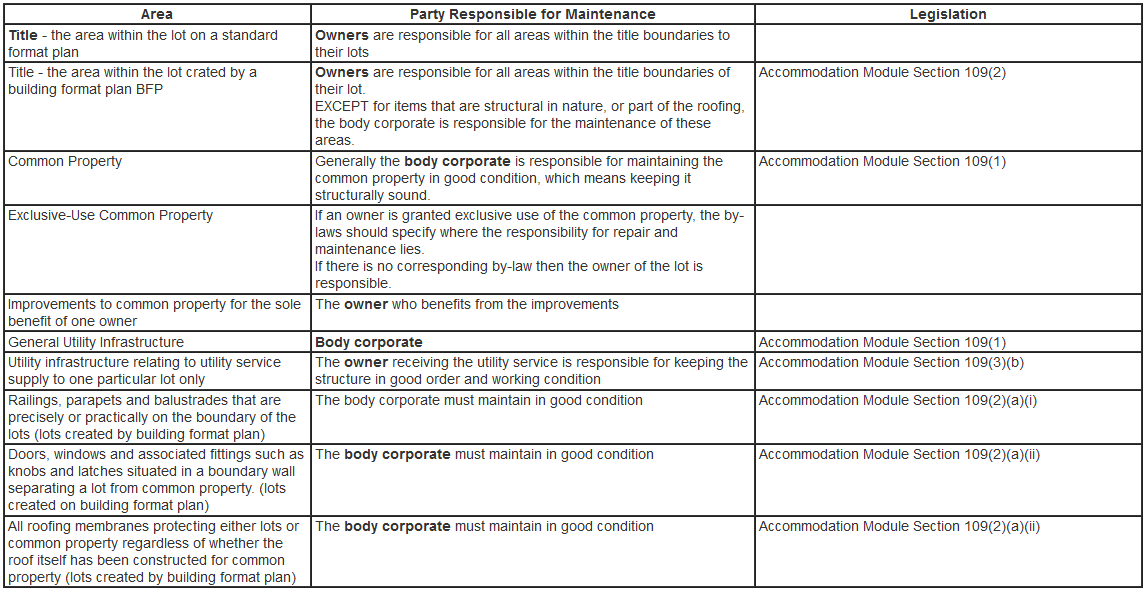
Common Property V Owner Lots
Common property is that part of the scheme land which is not part of a lot.
It includes most of the utility infrastructure (cables, wires, pipes, etc.) of the body corporate that is on common property and which services more than one lot.
A lot means the separate, distinct area (owned by each lot owner) created on registration of a plan of subdivision under the Land Titles Act and shown on a Title Deed.

It includes most of the utility infrastructure (cables, wires, pipes, etc.) of the body corporate that is on common property and which services more than one lot.
A lot means the separate, distinct area (owned by each lot owner) created on registration of a plan of subdivision under the Land Titles Act and shown on a Title Deed.
Ownership of Common Property
The common property is owned by all the lot owners (as tenants in common) in proportion to the interest schedule of lot entitlements.
If an owner has an interest in a lot, that person has an interest (as a tenant in common) in the common property.
For legal purposes, the body corporate is deemed to be the owner and occupier of common property.
It may sue or be sued, enter into dealings, and execute documents concerning the common property.
Lot Entitlements
A lot entitlement is the whole number (it can’t be zero) allocated to each lot in the lot entitlement schedules which appear in the Community Management Statement (CMS) of the Community Titles Scheme.
There are two lot entitlement schedules:
- Interest Schedule – used to determine each owner’s share of common property, their share of the scheme’s assets and liabilities if the scheme is terminated, for rating purposes and to calculate an owner’s share of the insurance premiums under a Building Format Plan;
- Contribution Schedule – used to determine an owner’s share of levies, when voting on an ordinary resolution by a poll and on a special resolution, and the owner’s share of some utility charges.
A lot entitlement schedule may be adjusted by applying to the court, by the order of a specialist adjudicator, by the written agreement of two or more owners.
It is a costly exercise to effect a change. It is also time-consuming for many stakeholders.

Duties of the Body Corporate
The body corporate must administer the common property and the body corporate assets reasonably and for the benefit of all the owners.
In administering this property, it shares a duty of care with other parties to provide a safe working environment under the terms of the Workplace Health and Safety Act.
The body corporate must maintain a mail-box (showing the name of the body corporate) located at or near the street alignment of the complex or make other suitable arrangements for the receipt of mail
(say, a mailbox at the post office)
The body corporate may opt to have a notice board to display notices, “house rules”, committee resolutions and matters of interest.